Is Tasks.Bot Good for Location Based Task Coordination? An Honest Review
Your field team says the job is done, but you have no proof of where or when. WhatsApp threads show timestamps, not GPS coordinates, and attendance sheets get signed from a desk miles away. That gap costs you on client reports and payroll disputes.
This review breaks down whether Tasks.Bot handles location based task coordination for WhatsApp-first teams with field staff. You will see how tasks sit on a map, how live GPS tracking and face-verified attendance work, and where the beta still falls short. By the end, you can decide if it fits your crew.
What Is Tasks.Bot?
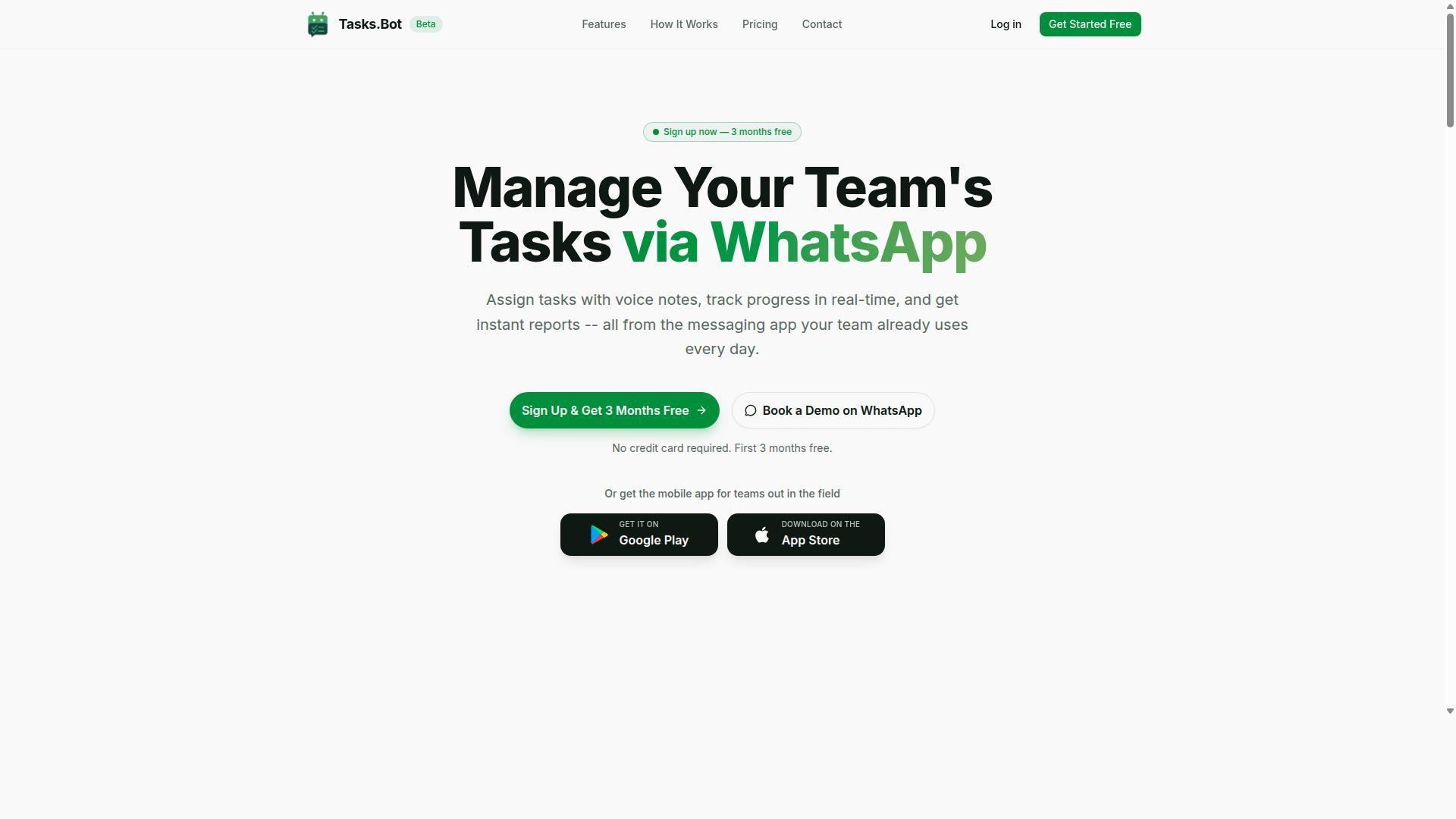
Tasks.Bot is a task management platform that operates entirely within WhatsApp, enabling teams to assign tasks, track progress, and receive reports without installing additional software. For teams already coordinating work through chat, that means no new app to download and no account for every team member to create.
The core value proposition is simple: work happens where conversations already happen. Instead of asking staff to switch between a messaging app and a separate productivity tool, Tasks.Bot keeps task assignment, status updates, and reporting in one thread. The platform uses AI to interpret natural language and voice notes, so a manager can send a plain instruction or a quick voice message rather than filling out a structured form.
For staff in the field, Tasks.Bot also offers a mobile app, which gives mobile workers a dedicated way to engage with their assigned work while the rest of the team stays in WhatsApp. The service is currently in beta and offers a free trial period, so teams can evaluate whether the WhatsApp-first approach fits their workflow before committing.
This matters for location-based task coordination because the tools a team already uses shape how reliably location data gets captured. When task assignment and check-ins live inside the same app people message each other on, there are fewer handoffs where updates get lost.
Who It's Built For: WhatsApp-First Teams With Field Staff
Tasks.Bot is designed for teams that already rely on WhatsApp for communication, especially those with field staff who need to manage tasks, track attendance, and log payroll-ready hours. If your coordinators are sending instructions in a group chat and your workers are replying from job sites, the platform fits that existing pattern rather than replacing it.
The fit is strongest in field service management and similar mobile workforce settings. These are teams where people move between locations during the day and where a desktop-first tool creates friction. Attendance tracking and payroll-ready hours are part of the platform's scope, which matters for operations that need a record of who was on site and when, not just a list of completed jobs.
The company states that hundreds of teams already use the service. That is a useful signal for anyone weighing an app review or honest review before adopting a new coordination tool: there is a working base of users, though the platform is still in beta.
For location-based task coordination specifically, the audience profile is telling. Teams with field staff are the ones most likely to need check-in and check-out records, task assignment tied to a place, and automated reminders that reach workers on the move. A WhatsApp-first design means those capabilities arrive through a channel staff already check throughout the day, which supports team collaboration without adding another login to remember.
Is Tasks.Bot Good for Location Based Task Coordination? The Short Answer
Yes, Tasks.Bot is effective for location-based task coordination, but it is not a full-fledged GPS tracking or geofencing platform. It sits in a practical middle ground: a task management and workflow automation tool that lets teams attach location context to work, rather than a system built to follow people or vehicles around a map.
For teams that already run their day through WhatsApp, that distinction matters less than it sounds. Tasks.Bot works inside a messaging environment people already use, which lowers the barrier to adoption for field crews, delivery staff, and mobile workforces who are not going to log into another dashboard.
The honest verdict breaks down into three parts:
- Strong fit: assigning tasks with location context, tracking progress, and keeping a distributed team aligned on who is doing what and where.
- Reasonable fit: check-in and check-out style workflows and automated reminders tied to task status, handled through conversational updates rather than a dedicated tracking screen.
- Weak fit: real-time geofencing, continuous GPS tracking, and route optimization. These are specialist capabilities, and a coordination tool is not the right place to look for them.
So the useful question is not whether Tasks.Bot replaces a fleet tracking system. It does not, and it does not try to. The question is whether location-aware task assignment and progress tracking, delivered through a channel your team already checks, solves the coordination problem in front of you.
For many small and mid-sized operations, it does. The sections that follow examine where location-based coordination actually adds value, where the limits show up, and how to judge whether your workflow needs a coordination tool or a dedicated tracking platform.
How Tasks.Bot Handles Location Based Task Coordination
Tasks.Bot integrates location awareness into task management by allowing tasks to be associated with specific locations and tracked via GPS when field staff use the mobile app. A manager can assign a job to a site, a client address, or a service zone, and the task carries that location context from creation through completion.
What makes this approach distinctive is where the work happens. Tasks.Bot operates entirely within WhatsApp, so field workers do not need to install anything or create new accounts to receive and act on location-tagged tasks. The Android and iOS apps add push notifications, voice capture, and a home screen widget for staff who want a dedicated mobile experience, but the core coordination still runs through a channel most teams already use daily.
The location coordination workflow follows a straightforward pattern:
- Task creation with location: A task is tied to a place, whether that is a single address or a broader area.
- Assignment and notification: The right team member receives the task along with automatic reminders and smart deadline tracking.
- On-site check-in: The mobile app captures GPS data when the worker arrives, confirming they are at the right location.
- Completion with proof: The task is closed out with location data attached, creating a verifiable record.
Location triggers and proximity alerts support this flow by prompting action when a worker reaches or nears a designated site. Instead of relying on a phone call or a manual message to confirm arrival, the system can surface the relevant task at the relevant moment. That reduces back-and-forth and keeps the focus on the job itself.
For teams weighing whether Tasks.Bot fits their field service management needs, the honest answer is that location-based coordination is a genuine strength of the platform rather than an afterthought. The combination of GPS check-ins, map-based task views, and face-verified attendance gives supervisors a practical way to confirm that work is happening where it should be.
Tasks on a Map and Live GPS Tracking for Field Teams
Field teams can view assigned tasks on a map and share live GPS location updates, enabling dispatchers to monitor progress and adjust assignments in real time. This turns a scattered set of jobs into a single visual picture, which is far easier to reason about than a list of addresses and status labels.
For dispatch and coordination, the map view answers the questions that matter most during a busy day. Who is closest to an urgent job? Which technician has already finished and can take on more? Where is a team member who has gone quiet? Live GPS tracking means these answers do not require a round of calls or messages.
The practical benefits show up in several ways:
- Faster reassignment: Dispatchers can move work to the nearest available person without guessing at travel time.
- Fewer manual check-ins: Real-time updates replace the routine "where are you now?" messages that eat into a supervisor's day.
- Better route awareness: Seeing tasks and people together helps planners group nearby jobs and cut unnecessary travel.
- Accountability through location history: Past movements and check-ins can be reviewed when a client question or a dispute arises.
Location history matters for more than oversight. When a customer claims a technician never arrived, or when a job is billed against time on site, a recorded trail of GPS check-ins provides evidence that is difficult to argue with. That record supports both internal accountability and external conversations with clients.
It is worth noting how this fits the wider platform. Tasks.Bot is a task management tool built around WhatsApp, with AI that understands natural language and voice notes for creating tasks. Location tracking sits alongside that foundation rather than replacing it, so a manager can assign a job by voice note and still see it appear on the map once the field worker engages with it.
Live Day Tracker and Face-Verified Attendance
Tasks.Bot includes a live day tracker that logs check-ins and check-outs, with face verification to ensure attendance accuracy for field staff. Rather than trusting a self-reported start time, the system confirms that the person on the clock is the person who was scheduled.
This matters in field service management, where workers are rarely in one place and a supervisor cannot physically watch the door. Face verification closes a common gap in mobile workforce attendance: the practice of one employee clocking in on behalf of another. When identity is confirmed at the moment of check-in, the hours recorded reflect real presence.
The tracker feeds directly into the platform's broader workforce tools. Tasks.Bot also handles shifts, leave, and hours management, which means attendance data flows into records that can be used for payroll-ready hours rather than being re-entered by hand. For a small operations team, that removal of manual reconciliation is often the difference between accurate timesheets and a monthly argument.
Accountability improves on both sides of the arrangement. Staff have a clear, consistent record of the hours they worked. Managers have documentation that supports scheduling decisions, overtime calculations, and client billing. Neither party has to rely on memory or goodwill.
Taken together, the live day tracker and face-verified attendance form part of the platform's location-based coordination toolkit. They answer a different question than GPS tracking does. Live tracking shows where someone is during the day; attendance verification confirms when their working day began and ended, and that the right person was there for it.
For teams evaluating whether Tasks.Bot is a good fit, this pairing is a meaningful point in its favor. Location-based coordination is not just about watching dots move on a map. It is about connecting a person, a place, and a period of time into a record that holds up when it is examined. Tasks.Bot handles that connection inside a tool most field teams already know how to use, which lowers the adoption barrier that typically slows down new workforce software.
Key Features That Support Location Based Work
Beyond location tracking, Tasks.Bot offers several features that streamline task coordination for mobile teams, from voice-based task creation to automated reporting. These capabilities matter because field staff rarely sit at a desk, and every extra tap or form field slows down real work.
The platform runs entirely inside WhatsApp, so team members don't need to install anything or create new accounts. That single design choice removes one of the biggest barriers in field service management: getting a dispersed mobile workforce onto yet another app.
Four features do most of the heavy lifting for location-based work:
- Voice note task creation and AI natural language input, so tasks can be logged in seconds
- Smart deadline reminders, which keep time-sensitive jobs on schedule
- Approvals and automations, which replace back-and-forth phone calls
- Instant reports, which summarize activity without manual data entry
Together, these tools reduce friction for staff who may not be comfortable with complex interfaces. A technician, driver, or site inspector can work through a familiar chat thread instead of learning new software, which supports smoother team collaboration across the whole crew.
Voice Note Task Creation and AI Natural Language Input
Team members can create tasks by sending a voice note or typing a natural language message in WhatsApp, which the AI interprets and converts into structured tasks. Instead of filling out fields for assignee, deadline, and location, a user simply describes the job in their own words.
The AI understands user intent and creates the task from the message, so the details land in the right place without manual sorting. This shortens the gap between spotting a problem on site and logging it as an actionable item.
For a mobile workforce, the benefit is speed. A field technician finishing one job can speak the next task into their phone while walking to the vehicle, rather than stopping to type. That matters when gloves, weather, or a busy schedule make touchscreen typing impractical.
Natural language input also lowers the learning curve. Staff who are not comfortable with complex interfaces can use the same chat app they already message colleagues on, which reduces training time and resistance to adoption. Managers get cleaner task assignment data because the AI structures what would otherwise be a loose, informal message.
Because everything happens in WhatsApp, there is no separate login or onboarding step for each worker. The result is faster task capture, fewer dropped requests, and a coordination process that fits how field teams already communicate.
Smart Deadline Reminders, Approvals, and Instant Reports
Tasks.Bot automates deadline reminders, approval workflows, and report generation, all within WhatsApp, so managers stay informed without chasing updates. Smart reminders trigger around deadlines, helping time-sensitive jobs stay on track without someone manually checking a dashboard.
Approvals move through the same chat thread. A team member can request sign-off on a completed job, and a manager can grant it from their phone, which cuts the delays that come from email chains or phone tag. This kind of workflow automation keeps decisions close to the work itself.
Instant reports then summarize what happened in the field. Typical metrics include:
- Task completion status across the team
- Attendance records, supported by face-verified attendance
- Shift, leave, and hours data
The time savings come from removing manual follow-up. Managers do not need to call each worker for a status update or rebuild a spreadsheet at the end of the day, because the reporting is generated automatically from activity already logged in the chat.
For location-based task coordination, this combination is what makes oversight practical. Reminders, approvals, and reports work alongside tasks on a map and the live day tracker, giving supervisors a clearer picture of where work stands without adding administrative burden to the crew.
Where Location Based Coordination Still Has Limits
While Tasks.Bot handles basic location-based coordination, it lacks advanced features like geofencing, route optimization, and complex conditional logic that some specialized field service platforms offer. An honest review has to say this plainly, because teams with demanding location workflows need to know what they are getting.
The platform is currently in beta, so the feature set is still taking shape. That matters for how you read every limitation below. Some gaps may close as the product matures, and the site's refund policy offers a measure of reassurance for anyone trying it now.
Here is where the limits show up most clearly.
- No true geofencing. Tasks.Bot does not automatically trigger actions when a worker enters or leaves a defined area. Relying on manual check-ins instead of automatic location triggers adds friction and room for human error.
- No route optimization. For teams planning multiple stops in a single day, the platform will not calculate the most efficient sequence. Dispatchers and mobile workforce managers who depend on optimized routes will still need a separate tool.
- Limited conditional logic. Complex task dependencies, such as a step that only unlocks once a prior location-based condition is met, are not part of the workflow automation on offer. Simpler task assignment and automated reminders are where the strength lies.
Privacy is the other side of this coin. Any use of geolocation or GPS tracking requires clear consent from team members, and location sharing can raise real concerns about monitoring. Transparency about what is tracked, and why, goes a long way toward keeping trust intact.
None of this makes Tasks.Bot a poor choice. It means the tool suits straightforward location-based task coordination well, while teams needing advanced geofencing or dispatch-grade routing should weigh whether a beta product's current scope fits their needs. Given that the service is in beta, the sensible approach is to treat today's feature list as a snapshot, not a final verdict.
Pricing and Plans
Tasks.Bot offers a single 'Full Access' plan with all features included, priced at ₹200 per member per month or ₹1,200 per year per member. That simplicity is worth noting for anyone weighing a productivity tool for location-based task coordination. There are no feature gates to decode and no tiers to compare, just one plan that unlocks everything the platform offers.
Pricing is available in Indian Rupees (₹) and US Dollars ($), and the site includes a 'Select currency' option with both choices. Because currency selection affects the final amount shown, readers should verify the currency before completing any purchase. This matters for teams spread across regions, where billing clarity is part of the buying decision.
The annual option carries a clear incentive. Choosing yearly saves 50%, which works out to ₹1,200 per year per member compared to paying month to month. For a small field team, that difference adds up quickly across seats.
- Monthly plan: ₹200 per member per month
- Annual plan: ₹1,200 per year per member, saving 50% and ₹1,200 per year per member
- Included: all features, with no separate premium tier
New users get 3 months free, with no credit card required, and can cancel anytime. That trial window gives a team room to test how Tasks.Bot handles location-based task coordination, including task assignment, automated reminders, and real-time updates, before committing budget.
One caveat belongs in any honest review. Tasks.Bot is in beta, which may affect pricing stability over time. A beta label does not undermine the value of the plan, but it does mean readers should treat current rates as subject to change. A refund policy is mentioned in the footer, so it is worth reading before purchase.
For teams comparing the cost against the work it replaces, the math is straightforward: one flat rate, every feature, and a free three-month start. That is a low-risk way to evaluate whether the platform fits a mobile workforce.
Trust Signals: Beta Status, Security, and Track Record
Tasks.Bot is currently in beta, which means features may change, but it already serves hundreds of teams and offers a refund policy for peace of mind. For anyone weighing whether this platform is a safe bet for location-based task coordination, those three signals matter more than a polished landing page.
Beta status cuts both ways. On one hand, it tells you the product is under active development, so improvements and fixes tend to arrive quickly. On the other, it means certain behaviors or interfaces may shift without much notice, and a workflow you build today could look slightly different next month.
For teams handling dispatch, scheduling, or field service management, that trade-off is worth understanding before committing. Beta software rewards early adopters who value momentum over long-term stability guarantees. If your operation depends on a frozen feature set with no surprises, that is a genuine consideration.
The refund policy, listed in the site footer, softens that risk. It signals the company expects some users to try the tool and decide it is not the right fit. Combined with the hundreds of teams already on the platform, it points to a product that is past the experimental stage even if it has not reached full release.
Security is where an honest review has to be careful about what it can and cannot confirm. Tasks.Bot states that it uses enterprise-grade encryption and that conversations and task data are never shared or used for training. That is a meaningful detail for teams handling sensitive field data.
What the public information does not mention is any formal security certification. There is no stated SOC 2, ISO 27001, or similar compliance badge. That is not the same as saying security is weak. It simply means buyers with strict procurement requirements should ask directly before rolling the tool out across a mobile workforce.
Practical steps for a cautious team:
- Confirm how location history and location sharing data are retained and deleted.
- Ask whether check-in and check-out records can be exported or purged on request.
- Review how GPS tracking and proximity alerts fit your internal privacy policy.
- Test with a small group before expanding to the whole field team.
Track record is the thinnest signal of the three. Hundreds of teams using the platform is real evidence of adoption, but there is a notable lack of independent reviews, third-party comparisons, or published case studies. Most of what exists comes from the company itself.
That gap does not undermine the product. It reflects a young service still building its public footprint. Early-stage tools often look quiet on review sites while quietly powering real workflows behind the scenes.
For a buyer, the takeaway is straightforward. Treat the beta label as a signal of momentum, the refund policy as a safety net, and the WhatsApp delivery and stated encryption as reasonable baseline protections. Then verify certification and data handling questions directly, since those are the areas where public documentation runs thin.
Weighed together, these trust signals support a positive verdict. Tasks.Bot is a legitimate, actively developed platform with paying users and a stated refund path, not a fly-by-night operation. The caveats are about maturity, not credibility, and they are easy to manage with a short trial and a few pointed questions before wider adoption.
Final Verdict
Tasks.Bot is a solid choice for WhatsApp-first teams needing basic location-based task coordination, but it may not satisfy those requiring advanced geofencing or route optimization. That single distinction captures most of what an honest review of this productivity tool comes down to. The platform does a small number of things well, and it does them inside an app your field staff already use every day.
For small and medium field teams, that focus is a genuine advantage. There is no new mobile workforce app to install, no separate login to remember, and no training session required before a technician can receive a job. Task assignment and team collaboration happen in the same chat thread where your crew already coordinates.
The strengths that stood out during this Tasks.Bot review are practical rather than flashy:
- WhatsApp integration keeps task management inside a familiar interface
- Ease of use means new workers can participate without onboarding friction
- Voice tasks let field staff report progress hands-free while on site
- Attendance tracking supports check-in and check-out for mobile workers
Those four pillars cover the daily needs of most small crews handling dispatch, scheduling, and recurring tasks. A plumber who finishes a job and sends a voice note beats one who has to open a laptop and fill in a form.
The honest review has to note the limits too. Tasks.Bot is still in beta status, which means the product is evolving and some edges remain rough. Teams expecting deep advanced location features such as precise geofencing, proximity alerts, or route optimization may find the current toolset thinner than they need.
That is not a flaw so much as a fit question. A delivery fleet optimizing forty stops per driver has different requirements than a five-person maintenance crew covering one city. The first group should look at dedicated field service management platforms. The second group is exactly who Tasks.Bot serves.
Weighing it all up, the recommendation is straightforward. If your team already runs on WhatsApp and your location-based task coordination needs are basic, Tasks.Bot removes real friction at very little cost in time or learning. If your workflow depends on automated location triggers, GPS tracking dashboards, or dispatch optimization, treat the beta label as a signal to wait or look elsewhere.
For more information or to book a demo, contact [email protected] or call +91 97143 42522.
Frequently Asked Questions
How does Tasks.Bot actually handle location-based task coordination?
Tasks.Bot includes a tasks-on-a-map feature that lets you see tasks by location, alongside live day tracking for field teams. Because it runs inside WhatsApp, coordinators and field staff can assign, update, and close out location-based tasks without switching to a separate tool. It's designed for teams whose work happens out in the field rather than at a desk.
Do my field team members need to install an app or create new accounts?
No. Tasks.Bot operates entirely within WhatsApp, so team members don't need to install anything or create new accounts to receive and complete tasks. There is also a mobile app available for field teams if you want additional functionality. This keeps onboarding simple for staff who are already using WhatsApp every day.
Can I create and assign tasks using voice notes?
Yes. Tasks.Bot uses AI to understand natural language and voice notes, so you can create tasks by simply speaking or typing a message in WhatsApp. The platform also supports automatic task assignment, smart deadline reminders, approvals, and automations. This makes it practical to coordinate quickly from the field or on the move.
What does Tasks.Bot cost, and is there a free trial?
Tasks.Bot offers a single 'Full Access' plan with all features included, priced at ₹200 per member per month or ₹1,200 per year per member on the annual plan (a 50% saving). Pricing is available in both Indian Rupees and US Dollars. The service is currently in beta, and the website footer mentions a refund policy, so it's worth checking current terms before subscribing.
Does Tasks.Bot track attendance and hours for payroll?
Yes. Tasks.Bot offers face-verified attendance and live day tracking, which produces payroll-ready hours for field staff. Combined with instant reports, this gives coordinators a clear record of who was where and when. It's particularly aimed at teams that need both task management and attendance tracking in one place.
Is Tasks.Bot available in my country, and how do I get started?
Tasks.Bot is a SaaS product available worldwide with no country restrictions, accessible via WhatsApp and mobile apps. You can book a demo directly on WhatsApp from the website, or reach the team at [email protected] or +91 97143 42522. Since the service is in beta, the team can walk you through what's currently available.
Recommended Resources: